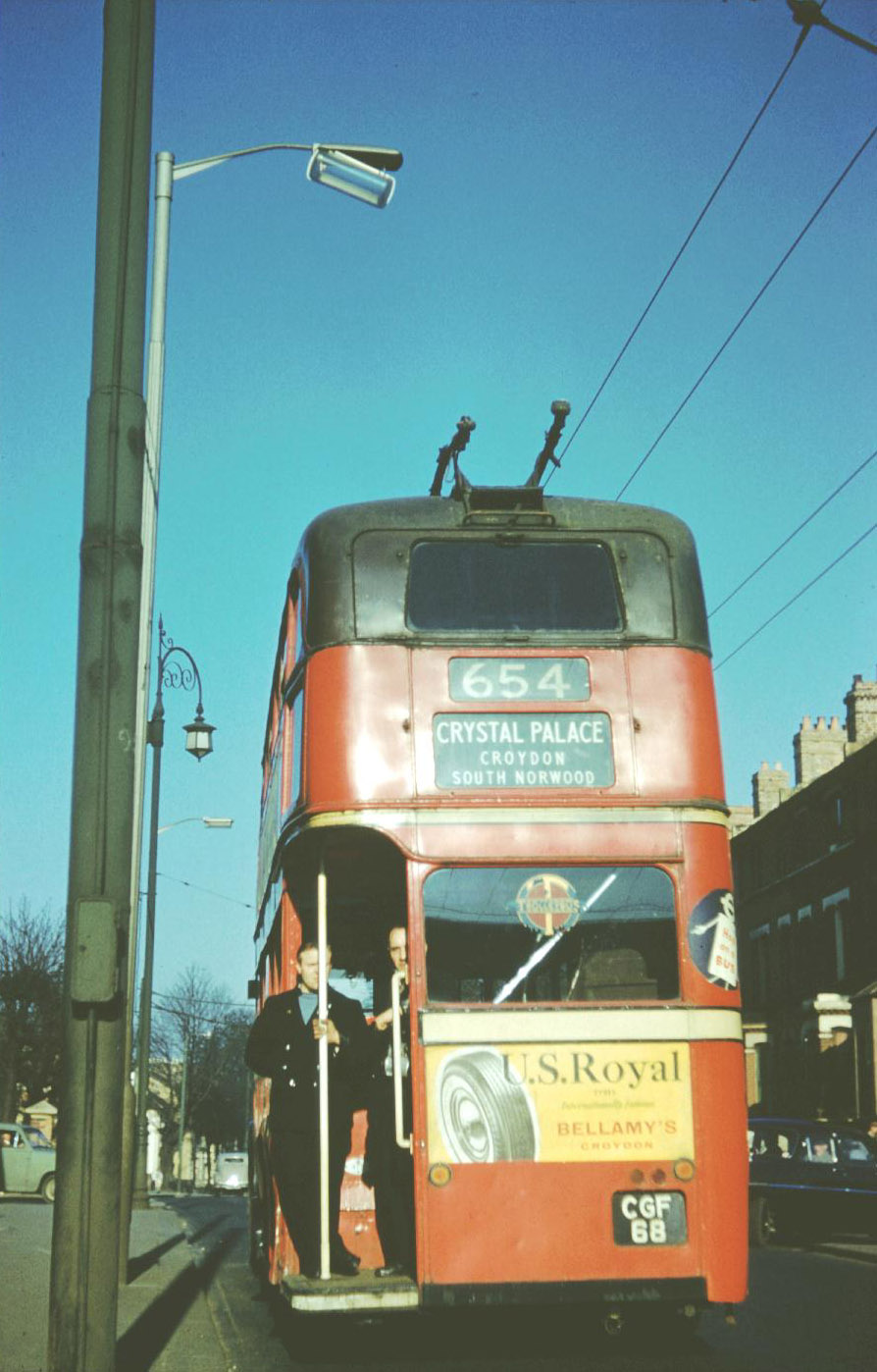
 |
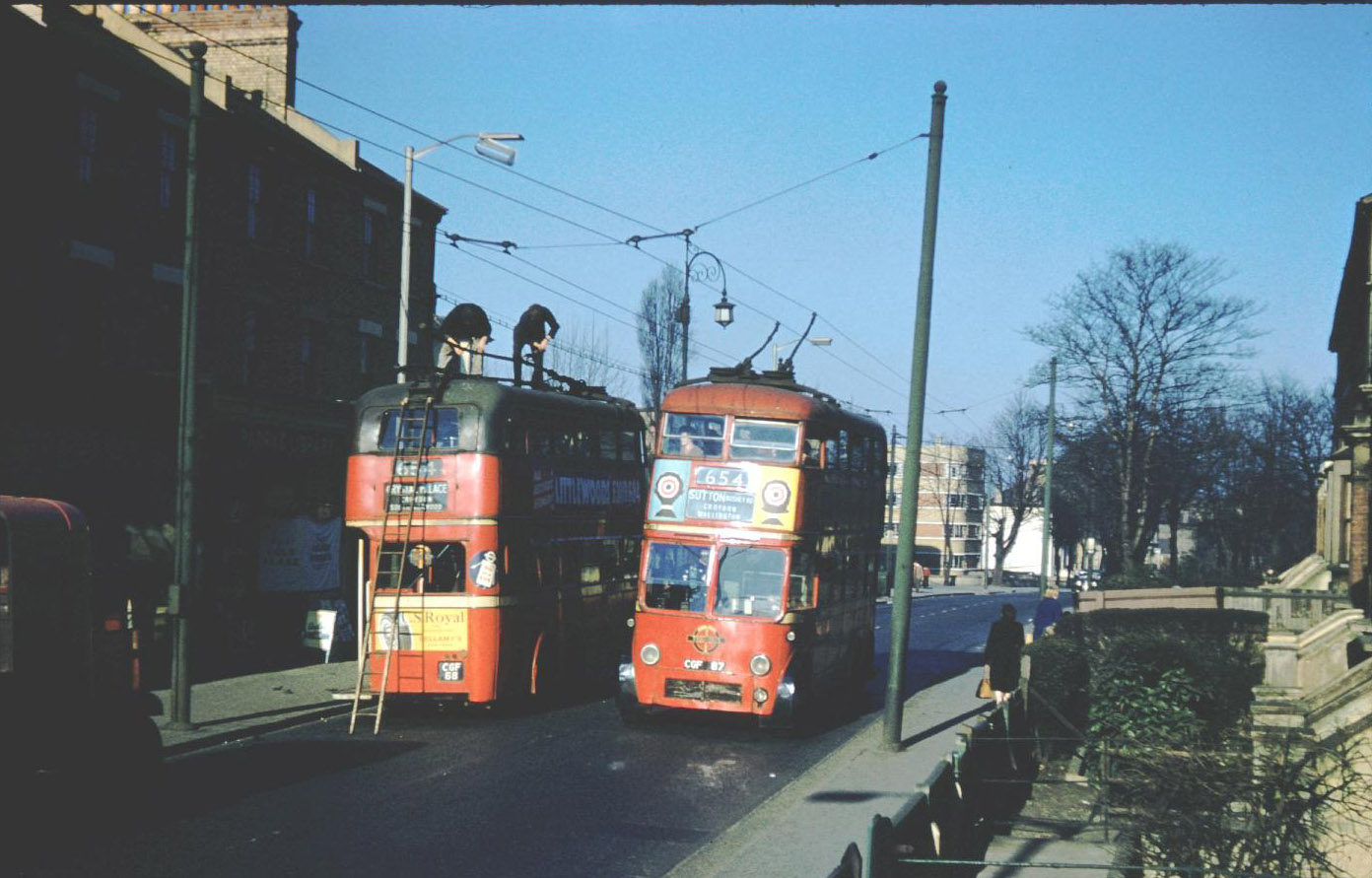 |
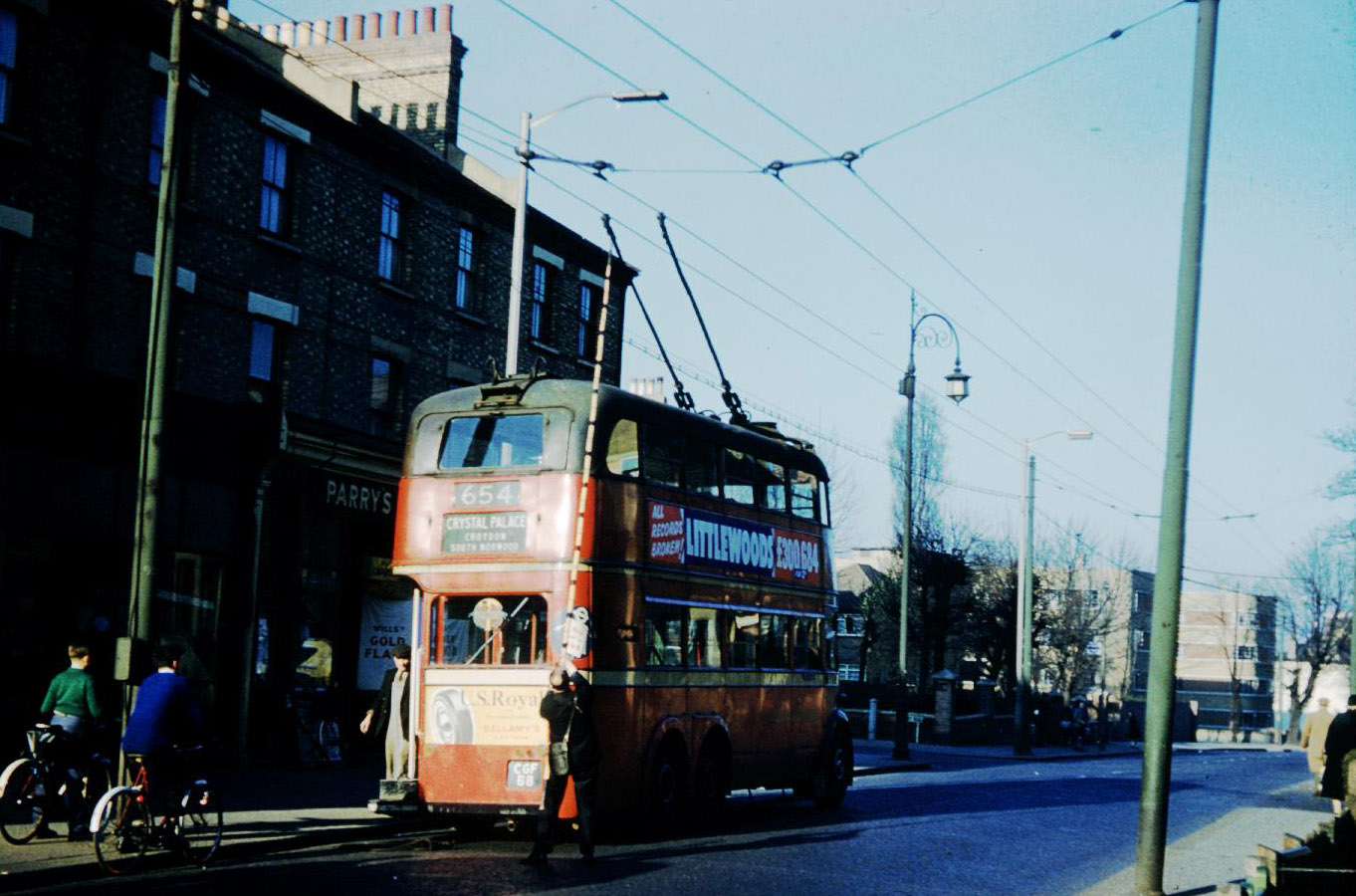 |
Pictures 62, 63 and 64. Click on each to enlarge. |
||
London Trolleybus on Route 654 with boom problems
From: "Chris Cook" <C.Cook@btinternet.com>
Picture 64 was taken from outside no.76 Penge Road, between Norwood Junction and the 'Robin Hood'
near the junction with Cambridge Road - just the Anerley side of the bridge carrying the Birkbeck-Crystal Palace
railway. I suspect that passage under the bridge had been a shade too enthusiastic - the wires dipped and rose
again at this point - leading to the need for the bamboo pole to fish in the sky. There is a Zebra crossing
immediately to your left now. that wasn't there in 1959.
The splendid set of chimney pots on the building opposite is now capped like this ^^^^; but the distinctive
set of four chimneys on the building beyond, appearing just above the trolleybus, is just the same.
The tobacconists "Parry's" behind the bus is now the "Golden Clouds Solarium" offering
"Turbo Sun beds" [what would the shoppers of 1959 make of that?] but the shop to its left, status uncertain in
the picture, is currently a newsagent's/tobacconists.
The trees have grown much bigger and you can no longer make out the then-new flats in the left-hand distance of
the 1959 view. The lamp standard behind the bus appears to be exactly the same; must have been new in the late 50's.
|
|
|
|
Pictures 62, 63 and 64. Click on each to enlarge. |
||
Comment by David Bradley:
From memory a running repair was completed in under half an hour. I wonder how they contacted the garage as there was no nearby public phone [mass mobile phone ownership started 30 years later]; and, who paid the 4d [unlimited time] call to the garage?
From: "Irvine Bell" <ibell@trolleybus.net>
Many British trolleybus systems 'floated' their trolleybus overhead i.e there was no ground connection and, theoretically, one could not get a shock by touching either conductor and 'ground' at the same time. In these situations, the wire nearest the kerb [on the left in Britain] was held at about -300 Volts and the other wire at about +300 Volts, giving a potential difference between the wires of about 600 Volts.
From: "David Perry"
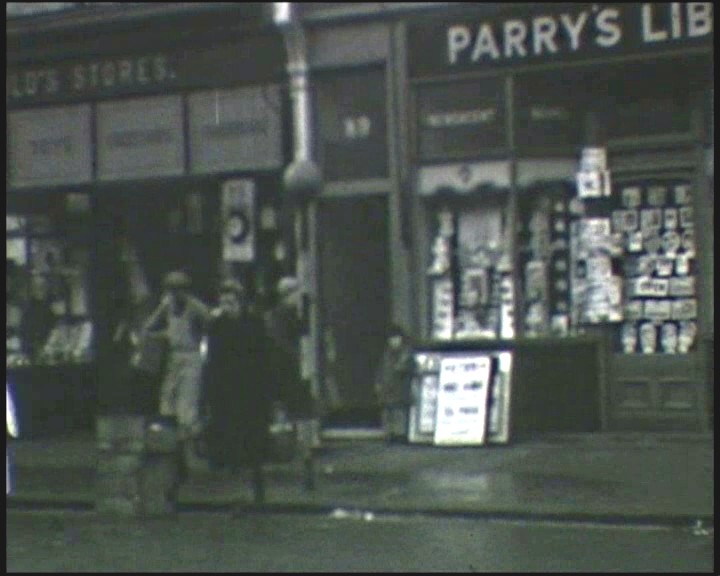
I was astonished and delighted to find your pictures 62, 63, & 64 on the web because between 1946 and 1949 I was
living in the top-floor flat above the tobacconist and newsagents 'Parrys Library', 89 Penge Road. The shop, owned by Basil Iddon, had a
telephone and this may have been used by the crew to summons help from the garage. The shop next door was a general store called Shergold's Stores.
The picture to the left [#P1] is a clip from a home cine film dated 1949 which shows the two shops, and, incidentally, the Belisha Beacon of a
pedestrian crossing.
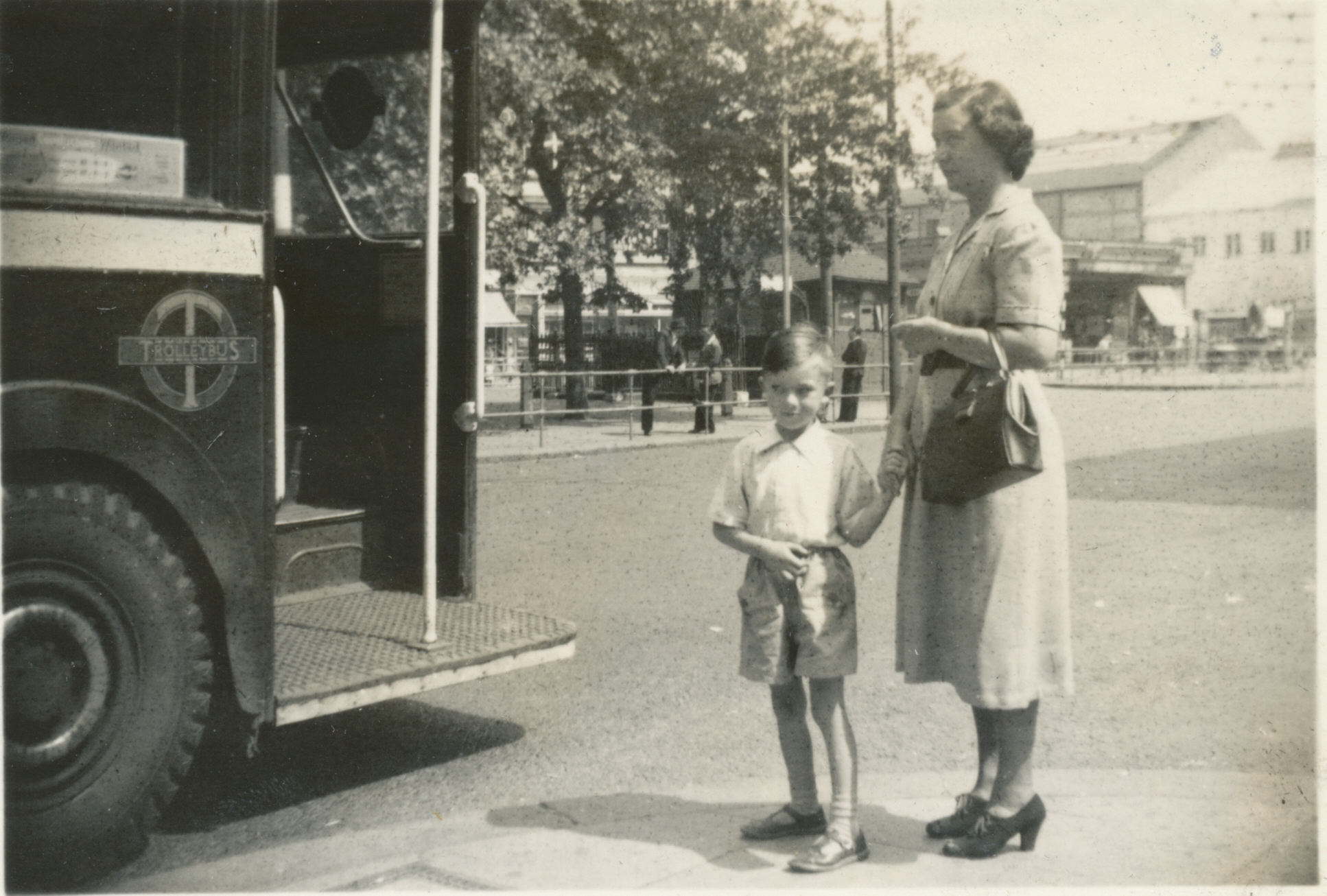
My web search was an attempt to identify the location of the picture to the right [#P2], dated 1951, which shows me and my mother standing by a trolleybus;
undoubtedly a 654. I suspected that the location was Crystal Palace, but the location looks nothing like that now. I recall that at the terminus
stop, the conductor placed a chock under a rear wheel to prevent the bus rolling down Anerley Hill in the event of brake failure.
Thanks for the web site. I would greatly appreciate being allowed to share those three photos with my extended family on our family tree web site
[access is restricted to family members only]. [Webmaster: PM sent to David with permission to use].
David Perry, Nottingham
From: "Ian McIver" <tibia_rex@yahoo.com.au>
It looks to me as though the trolley head has had a passing encounter with the street light, the glass of which appears to be hanging
quite dangerously. No wonder the boom was a bit bent!
Ian McIver, Brisbane
[Who remembers the 654 from the days of Croydon Airport]
From: "Terry Russell" <terry@terryrusselltrams.co.uk>
The trolleybus had rushed under Selby Road railway bridge and the poles de-wired, flailed about and hit the new lighting pole seen
in the background in pictures 62 and 63. Whilst waiting for the overhead line crew to arrive the driver got up and knocked down the dislodged street light
cover using the bamboo retriever and took it home for a fish bowl.
As for picture #P2, this is not on route 654, but somewhere far more busy. Double wires round a busy town centre with Tardis and shelter. Well maybe
not a Tardis, but a cabman's or bus inspectors hut and an UndergrounD toilet. Super picture - could have been me.
From: "Colin Vaughan" <niloc99@btinternet.com>
I reckon that is Shepherds Bush Terminus. I don't think that there is anywhere else on the entire Trolleybus Network where the OH
Linesman's art is depicted as well as in that two parallel route curve for Routes 607, 630, and 657 that took the 630 Route through the Green from Wood
Lane to Shepherds Bush Road, and on to Hammersmith Broadway, plus Routes 657 back to the Goldhawk Road, and the Route 607, back to the Uxbridge Road.
Looking at the rear wheel of the Trolleybus, it looks to me like a Leyland F1, so that looks like a 607 about to be boarded. However as the location
appears to lie slightly farther back from the stop at the Traction Pole with the frog switch, the Vehicle could be parked, poles up on the layby spur,
so it could be a 657, and maybe an H1.
A stroll through U Tube will show this terminus as it was in 1959/60, with the 607 traversing that curve before setting off along the South Side of the
Green then turning right past the former BBC TV Centre. Complete with musical background appropriate for the time, the presentation can be seem on YouTube
here with the area of interest appearing in the first few sequences of an hour
long film. It autally covers the entire 607 route pretty well, but inserts some of the 655 Route at one point.
On the far side of the road from your picture, just towards Bayswater there
used to be a towering edifice that housed the Franco-British Exhibition of 1908, somewhat before my time. It went courtesy of the Luftwaffe
in bombing Uxbridge Road Station. By 1951 all that had long since gone, leaving Shepherds Bush Central Line Station unscathed, although I just
remember it in 1939.
An addendum to my original thoughts, as I have noticed a curve in the curb there indicating the layby is slightly farther back, and a shadow
on the road a vehicle, probably a Trolleybus parked there. So our Leyland might be second in line, 607 behind 657? I must have stood in that spot that
your picture shows with my Mother, but by 1951 I was 15, and long since used the trolleybus on my own. I see the vehicle in the picture has a 'grippy'
looking tread, which tells me it might be at sometime traversing the hilly parts of South London, so that could be a 630 that the Lady and her Son were
about to board to 'escape' back to the South.
From: "Hugh Taylor" <isleworthdepot@trolleybus.net>
Shepherds Bush terminus. NEXT.
From: "David Perry"
Yes it's Shepherds Bush. Positively identified by the u-tube clip found by Colin Vaughan.
I guess we were visiting relatives in Hayes using the 607, and interchanging with the 630 at Shepherds Bush for travel to and from Croydon.
It is pleasing to get a result in so short a time. You must be a dedicated group of enthusiasts.
My thanks to all the contributors.
From: "Chris Cook" <C.Cook@btinternet.com>
The location is nowhere on the 654, as you suspected. Also, wrong kind of trolleybus for that route!
Is the bus, like the people, posing at a terminus? If it was at an ordinary stop there'd be a conductor on the platform; if in motion, it would be blurred.
Roundel position suggests very early post-war as white paint evident, but not long post-war.